
Agent Q Masterplan: Build Agentic AI's Prefrontal Cortex for Decision‑Critical Industries
By: Dr. Kostas Stylidis, Founder & CEO
Side Note: The prefrontal cortex (PFC) is the front part of the brain, behind the forehead, that handles planning, decision-making, problem-solving, and impulse control. It's where our highest-level cognitive functions live.
Background: I've spent over a decade in advanced automotive design and engineering, moving between academia and industry. I led research that created new ways to quantify how people perceive vehicles, and I saw firsthand how often critical design decisions still rely on guesswork. My sole focus now is Intended Future. I'm building this company with a long-term vision: to change how high-stakes decisions are made, using AI to amplify human judgment at scale.
The Mission
Deliver expert judgment at scale for every critical decision through advanced AI.
The Company
I believe that enabling better decisions is one of the most powerful ways to change the future. In the coming age, AI and Robotics will touch every decision that shapes value, safety, and trust. If we step in early and build the right kind of intelligence, we can set a positive course for decades.
That's why we founded Intended Future: to build AI that amplifies human expertise in domains where errors are expensive, visible, and sometimes deadly. We don't chase hype. We build expert agents for decisions that really matter—safety, quality, strategy, sustainability. If a choice could affect millions of lives or billions of dollars, I want AI in the room helping to make it better.
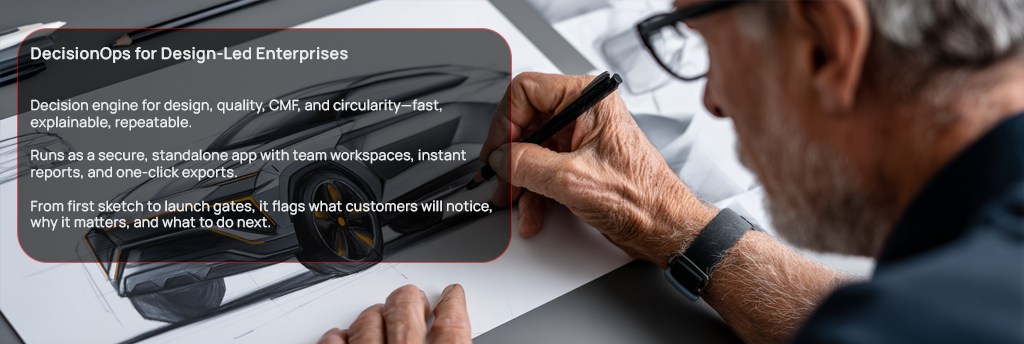
Our first product family is Agent Q, a set of agentic AI experts that combine neural networks with symbolic reasoning to deliver judgment at scale. We started in automotive design: Agent Q for Perceived Quality helps car makers understand, in advance, how customers will read every design choice. It's already being used by engineering and design teams at global OEMs, turning what once took weeks of subjective debate into minutes of explainable, customer-informed analysis. But Agent Q is just the beginning.
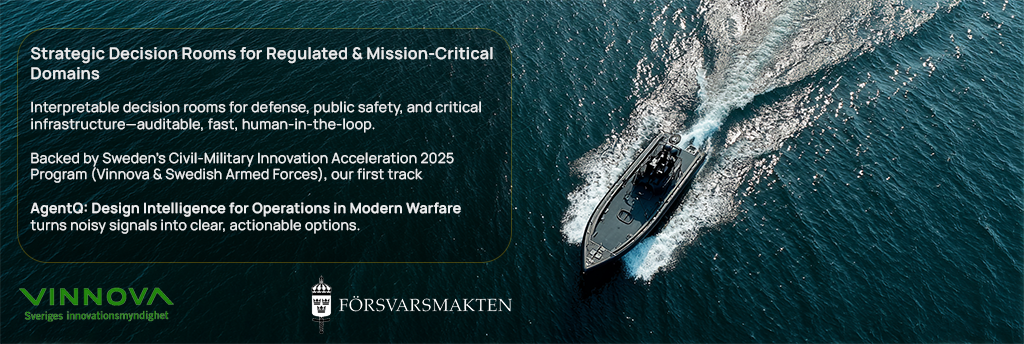
Our roadmap includes intelligent modules for Color–Material–Finish (CMF) decisions, Circular Design (sustainable product lifecycles), Architecture, Industrial Design, and Strategic Military Reasoning & Operations Planning. In simple terms, we're assembling a family of AI minds for critical domains. The long-term vision is for Agent Q to become the prefrontal cortex of any decision-critical system – including autonomous robots.
I know this journey will take time, and the challenge is not small. But if we succeed, we won't just build a strong company – we'll reset how the world approaches its most important decisions.
The World We're Deciding In Today
Right now, even our most crucial decisions suffer from a simple problem: we either lean on a few human experts and gut feel, or we drown in data with no clear narrative. In fields from automotive design to finance to defense, that mix creates delays, cost overruns, and sometimes human lives. Designers still ship products customers don't actually want. Leaders still make strategic calls with partial information. A lot of decisions that shape lives and industries are, honestly, made with crossed fingers.
The Future
We're at a tipping point. For the first time, we have the pieces to make sure no high-stakes decision has to be made in the dark. Every product design choice, every strategic plan, every complex operation could be checked by an AI partner that is fast, thorough, and deeply informed.
Imagine design teams getting instant feedback from an AI that understands exactly what customers will perceive and why. Imagine corporate and government strategists exploring dozens of scenarios in seconds, guided by a system that doesn't get tired, bored, or political. Once this technology is fully in place, blind spots in decision-making stop being "normal background noise" and start being rare exceptions. Innovation cycles shorten because we aren't stuck in endless trial-and-error.
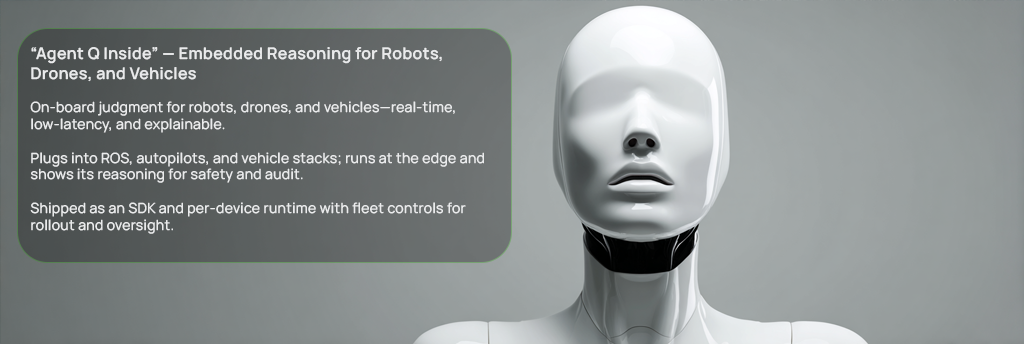
Further out, I see Agent Q's intelligence becoming the decision-making backbone of autonomous systems. Robots and self-driving vehicles won't just execute scripted tasks; they'll exercise judgment in real time – using the same core "brain" we developed for design and strategy. That's the direction of travel I care about: machines that don't just move, but actually decide in ways we can understand and trust.
How Agent Q Actually Works
We achieve this not by throwing a black-box algorithm at the problem and not by hand-coding every rule, but by combining the best of both worlds. Our solution is to build neuro-symbolic AI agents – systems that learn from data like a neural network but also reason with knowledge like an expert. Instead of guessing blindly or following a script, our agents understand context and causality, using machine learning to recognize patterns and symbolic logic to apply domain principles. This hybrid approach means the AI can adapt and learn while always providing a clear rationale for its conclusions.
Agent Q is designed as a platform: its architecture is modular and composable, with a general decision-making core that we can equip with domain-specific knowledge for each new application. When moving from car design to, say, military strategy, we don't start from zero – we teach the same core new "skills," which gives us a huge advantage in speed and consistency. All agents share the same DNA: transparent reasoning, the ability to ingest multi-modal data, and a framework grounded in human expertise.
Crucially, every Agent Q module is built to be interpretable. We reject the "black box" mentality. If our AI suggests a design change, it can show which factors led to that suggestion. If it flags a risk, it can walk through the chain of logic. That transparency turns the AI from a mysterious oracle into a teammate you can argue with, trust, and overrule when needed.
Our approach stands on real scientific foundations. We've integrated peer-reviewed frameworks like the Perceived Quality Framework from Chalmers University research and developed a Customer Acceptance Index™ to quantify consumer preferences, so our automotive agent doesn't just output a score for a car design – it leans on a proven model of what "quality" means to people. These methods have been validated in studies and trials, so when we deploy another agent in the real world, it's built on truths, not hype – an AI that thinks like an expert and scales like a computer.
Phase One: The Plan
In summary, here is the first phase of our Master Plan:
- Prove it in one hard domain. Continue delivering an AI agent for automotive perceived quality that matches or surpasses top human experts, and show that expert judgment can be scaled without losing nuance. Today, an independent benchmark showed 86% match to the human craftsmanship experts' team.
- Spread across other high-stakes arenas. Extend Agent Q into multiple domains – design aesthetics, sustainability, architecture, strategy, risk – and show that the same core approach works well beyond cars.
- Become the thinking layer for critical systems. Embed our agents as the "prefrontal cortex" for important operations across industries, governments, and autonomous systems. In practice: Agent Q becomes the default advisor for any mission-critical decision, whether the actor is human or machine.
We must have the ability to prevent costly mistakes, unlock groundbreaking innovations, and improve millions of lives in the process. We're not waiting for that future to arrive. We're building it now.

Kostas Stylidis, Founder & CEO